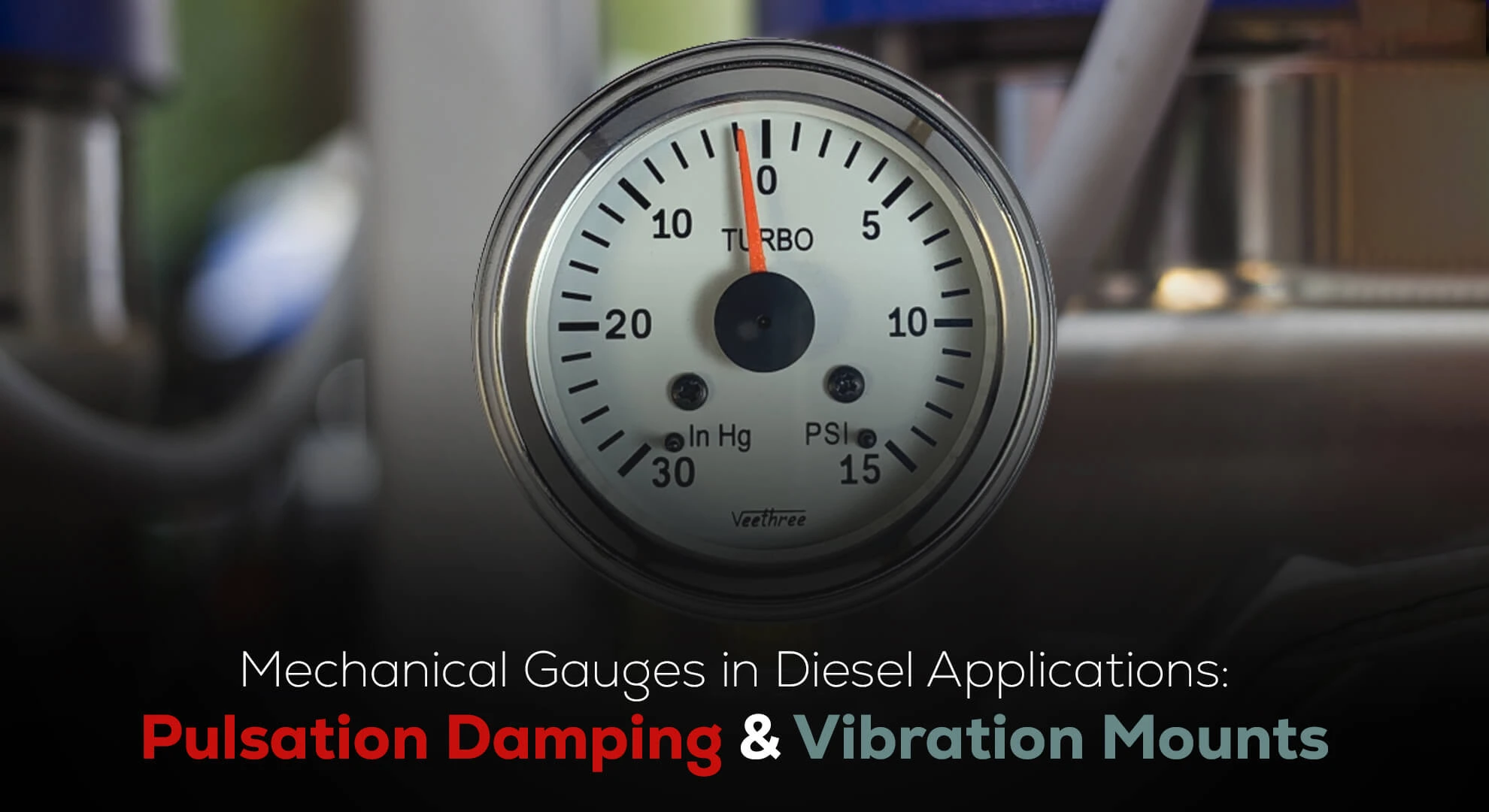

Why Mechanical Gauges still earn their keep on diesel kit
If your plant room or engine bay is all noise, heat, and shake, a well-specified Mechanical Gauge still makes a world of sense. There’s no boot-up time, no power dependency, and the reading is immediate. Brands like Veethree New Zealand supply broad ranges of mechanical gauges for marine and industrial use—oil pressure, fuel, air, boost, temperature—the lot—purpose-built for tough environments and straightforward to read briefly.
But even the best gauge can be chewed up by the two enemies of diesel systems: pulsation and vibration. The fix? Pair your gauge with a pressure gauge snubber (for pulsation dampening) and sit it on vibration isolation mounts, then mount it so the movement isn’t copping every hit.
The problem set: diesel pulsation and engine vibration
Diesel systems are lively by nature. Pumps and injectors create cyclic pressure waves; reciprocating machinery transmits vibration through pipework and frames. That’s why you’ll see needle flutter, fatigue of the Bourdon tube, and premature drift if the gauge is bolted straight onto a pulsing line or a shaking bracket. In common-rail and other high-pressure systems, those fluctuations are baked into the design—so you have to manage them.
First line of defence: fit a pressure gauge snubber for pulsation dampening
A pressure gauge snubber (also called a pulsation dampener, restrictor, or damping device) sits between the process and the gauge to tame pressure spikes and rapid oscillations before they reach the mechanism. Options include porous-element, piston-type, and adjustable needle snubbers. All aim to reduce pointer chatter, improve readability, and extend service life.
Quick picks (field-proven):- Adjustable snubber for variable conditions—tune the response without removing the gauge. Snubber vs restrictor? A snubber is adjustable/serviceable; a fixed restrictor is a simple orifice that works but can clog more easily in dirty service.
- Piston snubber for viscous media (fuel oil, hydraulic oil).
- Porous snubber for clean, non-viscous media (air, water, diesel).
needle flutter, unreadable average pressure, cracked lens from repeated spikes, or a gauge that dies young on a pump discharge or fuel rail tee.
Second line: choose liquid-filled gauges where the world shakes
A glycerin filled pressure gauge or silicone filled gauge cushions the movement, lowers needle flutter, resists condensation, and generally lasts longer in harsh vibration and pulsation. Silicone fill is better when it’s very hot or very cold, glycerin suits typical ambient ranges. In short, liquid-filled gauges lift readability and reduce failures in high-vibration diesel bays and on marine engines.
Third line: put the gauge on vibration isolation mounts and mount it smartly
Vibration isolation mounts—rubber or elastomer elements—decouple the gauge (or a small stand-off plate) from the vibrating structure. The aim is to cut the energy at the source so the Bourdon tube and movement don’t fatigue. Mount selection (hourglass vs cylindrical, durometer, static deflection) and layout (studs, plates, brackets) matter; the wrong shape or stiffness can transmit side loads or amplify certain frequencies.
Mounting tips that pay off:- Use a short, rigid gauge mounting nipple from the process, then a stand-off bracket on vibration isolation mounts to hold the instrument.
- Keep the dial upright and easy to eyeball; use panel mount or surface mount kits rather than hanging the gauge mid-air off a long spigot.
- Don’t bolt the gauge to a hot engine cover; move it to a cooler, steadier bulkhead and run a short impulse line.
- If the medium is dirty or pulsating hard, combine snubber + liquid-filled gauge + isolators. (Think of it like a three-legged stool—take one away and stability suffers.)
Selecting the right Mechanical Gauge for diesel service
1) Pressure range & safety marginPick a range where your normal operating pressure lands in the middle third of the dial; in pulsating service, aim closer to two-thirds of full scale to give headroom for spikes. That improves resolution and keeps the mechanism in its sweet spot. (oil pressure gauge, fuel pressure gauge, and air pressure gauge all follow the same logic.)
2) Materials & buildFor unknown or aggressive media, stainless wetted parts are the safe bet; for clean diesel and air, brass internals are common. If the process is sticky or dirty, use a diaphragm seal to keep debris out of the tube and movement.
3) Case type: dry vs liquid-filledDry cases are fine on steady lines in quiet locations. For diesel engine vibration or reciprocating pumps, a liquid-filled gauge is the better default.
4) Dial size & readabilityBigger dials help you catch trends from a distance—handy in engine rooms where you can’t stand still. (You’re chasing needle stability, not squinting.)
5) Connection & gauge mounting styleBottom entry suits pipe runs; back entry helps clean panel mount layouts. Keep impulse lengths short and supported; use a snubber close to the process.
The snubber setup: practical how-tos
- Place it first: Install the pressure gauge snubber between the process and the gauge, as close to the tapping as practical—upstream of any switch, too—so both instruments are protected.
- Adjustable beats fixed when conditions vary. Dial it in until the needle flutter stops but the gauge still follows legitimate changes.
- Serviceability: If you’re on fuel with fine particulates, choose designs you can clean rather than binning them when they clog.
The vibration isolation setup: practical how-tos
- Right stiffness: Pick vibration isolation mounts with static deflection suited to the instrument mass; too stiff = no isolation, too soft = sag and misalignment.
- Hourglass mounts handle side loads better than straight cylinders—handy for wall-mounted plates in moving vehicles or vessels.
- Orientation matters: Align studs with the dominant vibration direction and keep the lever arm (distance from mount to gauge mass) short.
Bonus reliability moves for diesel applications
- Liquid-filled case to control needle flutter and humidity in engine rooms. (glycerin filled pressure gauge for general service; silicone filled gauge for temperature extremes.)
- Calibrate sensibly: If the gauge informs safety or quality, schedule checks with traceable calibration and replace when drift or damage appears; don’t fight a losing battle with a tired movement.
- Right there at a glance: Use a bigger dial or remote the gauge to a calmer, more visible location. Your operators will catch issues sooner.
How this pairs with Veethree offerings in NZ
Veethree New Zealand carries a broad spread of Mechanical Gauges (alongside electronic and digital models) aimed at marine and industrial users across Aotearoa. That includes oil pressure gauges, fuel level and pressure gauges, vacuum & boost gauges, and temperature instruments, with product families that keep styling and sealing consistent for tidy dashboards and engine panels. If you’re standardising a mixed fleet—boats, gensets, plant—this makes spares and maintenance simpler.
Important note: This article recommends pressure gauge snubbers, pulsation dampeners, and vibration isolation mounts as best-practice add-ons for diesel service. Source those from your preferred industrial supplier to suit your media and pressure. (We’re not claiming they’re sold by Veethree NZ—this is simply good engineering hygiene.)
Field-ready checklist
- Fit a pressure gauge snubber on any line with noticeable pulsation (pump discharge, injector rail, compressor outlet). Tune adjustable types on site.
- Use liquid-filled gauges anywhere vibration or moisture makes life hard—the fill fluid damps movement and improves readability.
- Mount using vibration isolation mounts (hourglass or cylindrical) and keep impulse lines short and supported.
- Choose range so normal sits mid-dial; upsize to two-thirds if spikes are common.
- Relocate gauges away from heat and heavy vibration; use panel mount or bulkhead plates rather than cantilevered fittings.
Wrap-up: extend life through damping, isolation, and smart gauge mounting
If your Mechanical Gauges are suffering in diesel service, the cure is rarely exotic. Most failures trace back to pulsation, vibration, and poor mounting. Add a pressure gauge snubber for pulsation dampening, choose liquid-filled gauges where the world shakes, sit them on vibration isolation mounts, and select a range that puts normal pressure in the sweet spot. Do that, and you’ll see steadier needles, fewer replacements, and more trustworthy readings—day in, day out.
For marine and industrial users around New Zealand, Veethree’s range of mechanical gauges gives you a solid starting point; match them with the right accessories and installation and they’ll go the distance.